


Hiatus hernia surgery
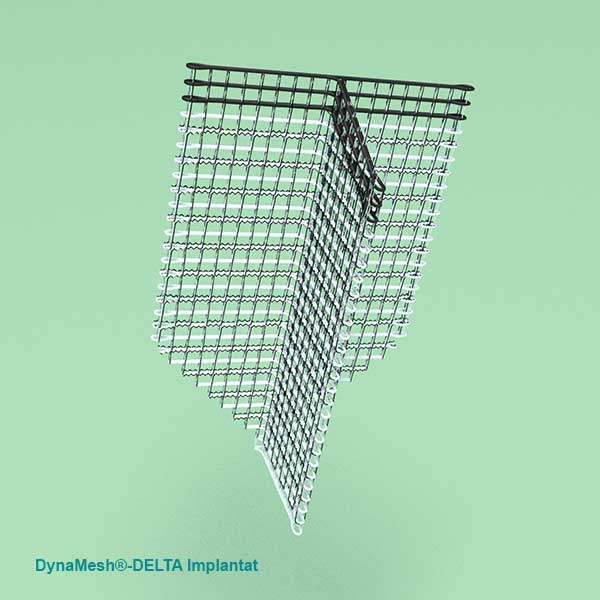
The aim of the surgical technique described here for the repair of a diaphragmatic hernia is to reconstruct the natural anatomy, in which the oesophagus is returned to its physiological position. This is achieved by using a specifically developed mesh implant, DynaMesh®‑DELTA. Compared to other approaches which use larger mesh implants inserted over the two limbs of the diaphragm, the mesh used here is significantly smaller and more compact. A smaller mesh also means that there is less foreign material in the body.
The mesh consists of two wings and a central bridging section (nose-piece), which permanently reinforce the closure of the diaphragmatic hernia. The duration of the surgery depends on the individual situation at initial assessment. Around one hour is needed for the surgery on average, and it is performed laparoscopically, i.e. using a minimally-invasive ‘keyhole’ technique.
The surgical technique was developed by Priv.-Doz. (Associate Professor) Dr. Eckhard Löhde, who performed the procedure together with his senior physician, Florian Thomas, at the DRK Clinics in Berlin from 2003 to 2014. The so-called LOEHDE (approach laparoscopic oesophago-hital DeltaMesh enhancement) is only performed by doctors who have undergone extensive training in this method and have appropriate experience with this specific technique.
Who can benefit from surgery?
The surgery described here is generally appropriate for patients who have finished growing (i.e. not children/teenagers) and who suffer from an axial and/or paraesophageal hiatus hernia.The use of the mesh is indicated when using a simple suture technique for closing the enlarged opening in the diaphragm would be associated with a high risk of recurrence of the hernia.
In essence, however, a medical decision for surgical intervention must always be made on an individual basis for each patient. It is vital in this regard to take a careful medical history from each patient, and to perform comprehensive investigations prior to any surgery. The surgeon will only recommend proceeding with the operation once all the patient-specific criteria are met. The operation is then only performed after in-depth informed consent discussions have been conducted.
Preparatory investigations
As well as taking a detailed medical history and carrying out an assessment of the symptoms, specialist investigations can be used to provide information as to whether the surgical technique is an appropriate option in the individual’s specific case. The investigations required will depend on the patient’s status at initial assessment, the clinical picture, and the indication for treatment. The doctor will come to a decision for each patient on an individual basis. They will explain how the diagnostic tests will be performed and can answer any questions in detail.
Hiatus Hernia Surgery – Surgical Procedure
This page will outline the 5 steps involved in performing the surgery for hiatus hernia repair. Please rest assured that we will not display any real-life images from surgery. The individual steps are illustrated using drawings and explained in clear, easy‑to‑understand text.
Instructions to follow after surgery
The patient has to do their part to contribute to achieving optimal treatment results by adhering to certain instructions given for after the surgery. These instructions are explained in detail by the treatment doctor during consultations held both before and after surgery.
• Patients should avoid physical activities such as sports or heavy lifting in the initial period after surgery. The doctor will then make a decision over the course of follow-up as to when full activities can be resumed.
• Certain factors, such as constipation or significant weight gain, can increase the risk of recurrence (i.e. the hernia coming back). This risk can be lowered by following an appropriate diet. The treatment doctor will provide advice on optimal nutrition following the surgery.
• If any other health issues occur after the operation, the treatment doctor should be contacted immediately.
Possible Contraindications
Patients who meet the following criteria (termed ‘contraindications’) on initial assessment are not suitable for undergoing the surgical procedure:
- Acute or chronic infections in the region where the mesh is to be implanted
- Growth phase not yet complete (e.g. children/teenagers)
- Hypersensitivity (allergy) to one of the substances contained in the mesh implant
- Cases where a case-by-case assessment reveals that the benefit from the procedure would not outweigh the associated risks.
Sources:
1 Fuchs KH, Babic B, Breithaupt W, Dallemagne B, Fingerhut A, Furnee E, Granderath F, Horvath P, Kardos P, Pointner R, Savarino E, Van Herwaarden-Lindeboom M, Zaninotto G; European Association of Endoscopic Surgery (EAES). EAES recommendations for the management of gastroesophageal reflux disease. Surg Endosc. 2014 Jun;28(6):1753-73.
Kohn GP, Price RR, DeMeester SR, Zehetner J, Muensterer OJ, Awad Z, Mittal SK, Richardson WS, Stefanidis D, Fanelli RD; SAGES Guidelines Committee. Guidelines for the management of hiatal hernia. Surg Endosc. 2013 Dec;27(12):4409-28.
Markar SR, Menon N, Guidozzi N, Kontouli KM, Mavridis D, Andreou A, Berlth F, Bonavina L, Cushieri A, Fourie L, Gossage J, Gronnier C, Hazebroek EJ, Krishnadath S, Low DE, McCord M, Pouw RE, Watson DI, Carrano FM, Ortenzi M, Antoniou SA. EAES Multidisciplinary Rapid Guideline: systematic review, meta-analysis, GRADE assessment and evidence-informed recommendations on the surgical management of paraesophageal hernias. Surg Endosc. 2023 Nov 1.
2 Löhde EH, Thomas F (2022) Results of a prospective, uncontrolled, single-arm study of 1,351 patients with hiatal hernia operated on exclusively with DeltaMesh hiatal reconstruction over a 10-year period. Laparosc Surg 6.